

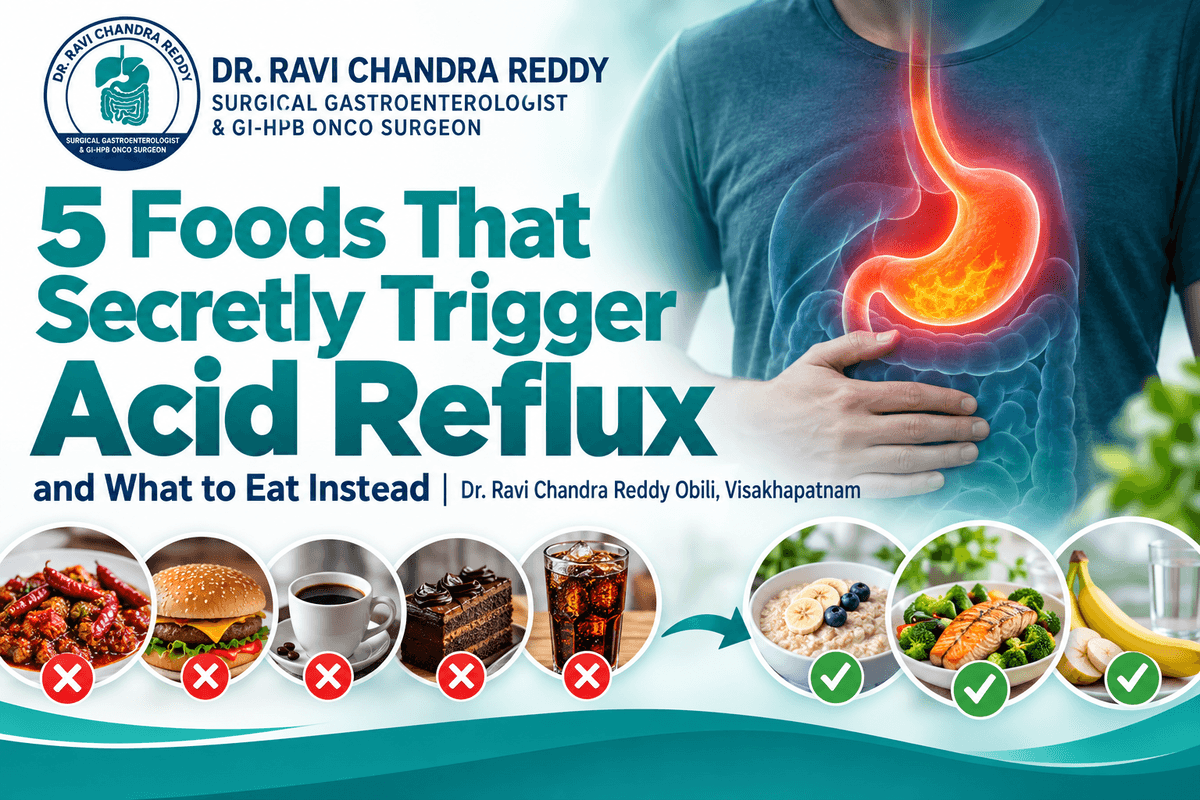
5 Foods That Secretly Trigger Acid Reflux — And What to Eat Instead
By Dr. Ravi Chandra Reddy Obili | Gastroenterologist, Krishna Nagar, Visakhapatnam
That Burning Feeling After Every Meal Is Trying to Tell You Something
You finish lunch — a simple plate of rice, sambar, and a small portion of pickle — and within twenty minutes, that familiar fire crawls up your chest. You reach for an antacid. The burning fades. You move on.
If this sounds like your daily routine, you are not alone. Acid reflux is one of the most common digestive complaints in India, and nearly one in five Indian adults reports weekly reflux symptoms, driven by spicy diets, erratic mealtimes, sedentary jobs, and rising obesity rates.
The problem? Most people assume the culprit is always the obvious — the extra-spicy curry or the midnight biriyani. In reality, several everyday foods that seem completely harmless are quietly making your reflux worse every single day.
As a gastroenterologist serving patients across Krishna Nagar, Maharanipeta, and throughout Visakhapatnam, I see this pattern repeatedly in my clinic. Patients arrive having popped antacids for months — sometimes years — without ever addressing the root dietary triggers. This blog is here to change that.
Why Does Acid Reflux Happen? The Direct Answer
Gastroesophageal reflux disease (GERD) is marked by the frequent occurrence of stomach acid flowing back into the esophagus, causing symptoms such as heartburn and acid regurgitation at least once a week.
The lower esophageal sphincter (LES) has a resting pressure that normally prevents stomach content and acid from entering the esophagus during digestion. Chocolate, coffee, tea, and energy drinks contain compounds — such as caffeine and theobromine — that weaken the tone of this sphincter. When its resting pressure decreases, reflux is more likely.
Diet is one of the most powerful — and most modifiable — risk factors. According to a meta-analysis published in the Indian Journal of Gastroenterology, the pooled prevalence of GERD in India is 15.6%, with key risk factors including BMI, non-vegetarian diet, and tea/coffee intake.
If untreated, GERD can lead to complications like esophageal inflammation, ulcers, or Barrett's esophagus — a pre-cancerous condition. The good news: targeted dietary changes can significantly reduce symptoms and prevent progression.
The 5 Foods Secretly Making Your Reflux Worse
1. 🍵 Your Morning Chai (and Evening Coffee)
This is the hardest one for most patients in Visakhapatnam to hear. Your morning cup of coffee, afternoon chai, or that fizzy cold drink can all relax the LES and increase acid production. Strong tea on an empty stomach — a near-universal habit along the Krishna Nagar area — is one of the most consistent triggers I observe in my patients.
Swap it with: Warm ginger water, coconut water, or chamomile tea (without milk).
2. 🧅 Raw Onion and Garlic
Many patients are shocked to learn this. Onions and garlic are foundational to Andhra cuisine — the base of almost every curry, chutney, and rice preparation. Citrus fruits, tomatoes, onions, and garlic are common triggers for many individuals. Raw onion in particular is especially problematic at night when lying down gives acid an easy pathway upward.
Swap it with: Cook onions thoroughly and use asafoetida (hing) as a flavour base in moderate amounts. Avoid raw onion salads at dinner.
3. 🍟 Fried Snacks (Mirchi Bajji, Samosas, Pakoras)
Whether it's mirchi bajji from a Maharanipeta street stall or pakoras at home, fried foods are major reflux offenders. Many participants in dietary studies occasionally consumed fatty or fried foods, which can stimulate the production of gastric juice and exacerbate GERD symptoms. Fatty foods slow down gastric emptying, prolonging the time food remains in the stomach. More time in the stomach means more pressure on the LES — and more acid creeping upward.
Swap it with: Steamed idli, soft-boiled sweet potato, or air-popped makhana (fox nuts) as snacks.
4. 🥛 Full-Fat Dairy (Paneer, Whole Milk, Cream-Based Curries)
This one surprises many patients. Andhra meals often feature rich paneer gravies, creamy curd preparations, and whole milk in chai. High-fat dairy products, such as whole milk used in chai and mithais and dishes like paneer tikka, can be major triggers for acid reflux. The fat content relaxes the LES and slows digestion simultaneously — a double blow for reflux sufferers.
Swap it with: Low-fat curd (dahi), skimmed milk, or plant-based milks. Opt for paneer in small amounts, lightly grilled, not deep-fried.
5. 🥤 Carbonated Drinks and Packaged Juices
Cold drinks, soda, and packaged fruit juices are widely consumed in Visakhapatnam, especially in summer. Studies from India found that carbonated soft drink intake was strongly associated with GERD, with an odds ratio of 2.48. The bubbles in fizzy drinks expand in the stomach, increasing pressure and pushing acid upward, while packaged juices carry hidden acids and sugar that irritate the esophageal lining.
Swap it with: Plain water, tender coconut water, or buttermilk (diluted, low-spice chaas).
What TO Eat: A Gastroenterologist-Approved Plate for Visakhapatnam Patients
Eating well with acid reflux does not mean eating bland or giving up your favourite flavours. It means smarter choices:
- Whole grains: Oats and barley are alkaline grains excellent for soaking up excess stomach acid. A simple oats porridge can be very soothing during a flare-up.
- Alkaline fruits: Bananas are naturally alkaline and coat the esophageal lining. Pears, melons, and apples are all well-tolerated.
- Gut-friendly vegetables: Indian gourds — lauki (bottle gourd), turai (ridge gourd), bhindi (okra) — are among the best vegetables for GERD patients. They are alkaline, easy to digest, and gentle on the stomach lining.
- Light meals and better timing: Prefer smaller meals every 3 to 4 hours instead of 2 to 3 heavy meals, and finish dinner at least 2 to 3 hours before going to bed.
- Fennel seeds: Chewing on a teaspoon of fennel seeds after your meal can help prevent the backup of acid and reduce gas, which often contributes to that burning feeling.
Why Professional Care Matters: The Evidence
Dietary changes alone help many patients — but chronic GERD requires proper diagnosis and a personalised management plan. Barrett's esophagus is a condition where the esophagus lining changes due to chronic acid exposure, and it can increase the risk of esophageal cancer, requiring regular monitoring even in the absence of symptoms.
Research in southern India found a GERD prevalence of 22.2%, with the condition being more common among older subjects and men. People residing in urban communities were significantly more vulnerable to GERD than those in rural communities. Visakhapatnam's rapid urbanisation, changing food habits, and high-stress coastal city lifestyle place its residents squarely in this higher-risk group.
At my gastroenterology practice in Krishna Nagar, Visakhapatnam, I offer a structured, evidence-based approach to GERD management — from detailed dietary counselling and endoscopic evaluation to long-term treatment plans that address root causes rather than just suppressing symptoms with daily antacids.
Specialists in gastroenterology possess a deep understanding of the complexities of GERD, allowing them to provide targeted and personalised treatment plans — addressing the root causes of acid reflux rather than just treating the symptoms.
For many patients, burning, sour belching, and post-meal heaviness reduce within 3 to 4 weeks when diet and meal timing are followed consistently under medical supervision.
Frequently Asked Questions (FAQ)
Q1: Is acid reflux the same as GERD?
No — they are related but not identical. Heartburn is considered a symptom, whereas GERD is a true digestive condition. Heartburn is a burning sensation in the chest or upper abdomen usually caused by regurgitation of acid from the stomach into the esophagus. Occasional reflux is common, but if symptoms occur more than twice a week, it is classified as GERD and requires medical evaluation.
Q2: Can spicy Andhra food permanently damage my food pipe?
Yes, over time, it can. Left unchecked, repeated reflux can injure the oesophagus and evolve into gastro-oesophageal reflux disease (GERD). In severe cases, this leads to erosive esophagitis or Barrett's esophagus. Patients in Visakhapatnam who enjoy the region's famously spicy cuisine should monitor their symptoms and consult a gastroenterologist if heartburn becomes frequent.
Q3: Are antacids safe to take daily for acid reflux?
Antacids provide short-term relief but are not a long-term solution. Chronic, unmanaged heartburn is a glaring warning light on your body's dashboard. Silencing that warning light with daily pills, without truly understanding the root physiological cause, can trigger a devastating domino effect throughout your entire system. Long-term self-medication can mask serious conditions. Always seek a specialist's opinion.
Q4: Where can I find a gastroenterologist for acid reflux near Maharanipeta or Krishna Nagar, Visakhapatnam?
If you are based in Maharanipeta, Krishna Nagar, or anywhere in Visakhapatnam and experiencing persistent heartburn, bloating, or regurgitation, you can consult Dr. Ravi Chandra Reddy Obili — a gastroenterologist practising in Krishna Nagar. A structured in-person evaluation is far more effective than self-diagnosing based on symptoms, as online information should support — not replace — professional medical advice, and digestive symptoms can overlap among many conditions.
Q5: When should I see a doctor for acid reflux instead of trying home remedies?
See a gastroenterologist immediately if symptoms are severe or escalating. Vomiting blood, passing black tarry stools, severe chest pain, or sudden swallowing difficulties should be followed by immediate emergency examination, as these are signs of acute upper GI complications. For milder but persistent symptoms — heartburn more than twice a week, difficulty swallowing, or unexplained weight loss — schedule a consultation rather than relying solely on dietary adjustments.
This blog is for educational purposes only and does not constitute medical advice. Please consult Dr. Ravi Chandra Reddy Obili or a qualified gastroenterologist for a personalised diagnosis and treatment plan.
Visit Us
Visit Ravi Chandra Reddy Obili - Gastroenterologist for trusted, compassionate care. We're here for you and your family.
Ravi Chandra Reddy Obili - Gastroenterologist
Krishna Nagar, Visakhapatnam, Andhra Pradesh
Phone: 917337422216
Website: drravichandrareddygastrosurgeon.com
Google Maps: https://www.google.com/maps/place/?q=place_id:ChIJz1HwTwBpOToRjUbDE0b-PrM
Email: help@drravichandrareddygastrosurgeon.com